TradeScope.trade
Blog β€Ί Trader Sentiment
πŸ“‹ TRADING CONTEXT

How to Follow Traders Without Getting Lost in the Noise
June 19, 2026 Β· 10 min read

You follow 15-20 traders on X. You're in three Discord servers and two Telegram groups. Every day, hundreds of posts flow through your feed β€” trade calls, chart screenshots, memes, macro takes, alpha leaks, and arguments about nothing. Somewhere in that noise, there's valuable signal. But finding it feels like a full-time job.

This is the paradox of following traders: the more sources you track, the less clarity you have at the moment of decision. The problem isn't missing information β€” it's that the information arrives disconnected from the asset you're trading. By the time you see a useful post about BTC, you've already checked three other sources, lost your conviction, and watched the entry pass.

Key insight: Following traders isn't about consuming more tweets β€” it's about anchoring trader sentiment to the specific assets you care about. Filter by asset, not by source.

The Problem with Feed-Based Following

Following traders through social media feeds has three structural flaws that no amount of curation can fix:

1. Chronological chaos

A trader's bullish post about ETH from three days ago is still relevant today β€” but your feed buried it under 200 newer posts. When you're evaluating an ETH trade, you need the cumulative sentiment from the traders you trust, not just whatever someone posted in the last hour. But standard feeds don't aggregate β€” they chronologically dump.

2. Context fragmentation

Trader A posts their ETH analysis on X. Trader B posts theirs in a Discord channel. The on-chain data is on a dashboard. Your own notes are in a spreadsheet. To make an informed ETH decision, you'd need to open five apps, mentally track the latest from each trader, and reconcile conflicting views β€” all before the market moves.

3. Information without attribution

When you see a post that says "ETH looking weak here," you don't know if this trader has been bearish on ETH for weeks (consistently right? consistently wrong?) or if this is a fresh flip. Without the trader's track record on that specific asset visible at the same time, every post carries equal weight β€” and that's dangerous.

Filter by Asset, Not by Source

The most effective way to follow traders is to invert the model. Instead of asking "what did this trader post today?", ask "what are the traders I follow saying about this asset?"

This shift β€” from source-first to asset-first β€” is the core of contextual trading. Here's what it looks like in practice:

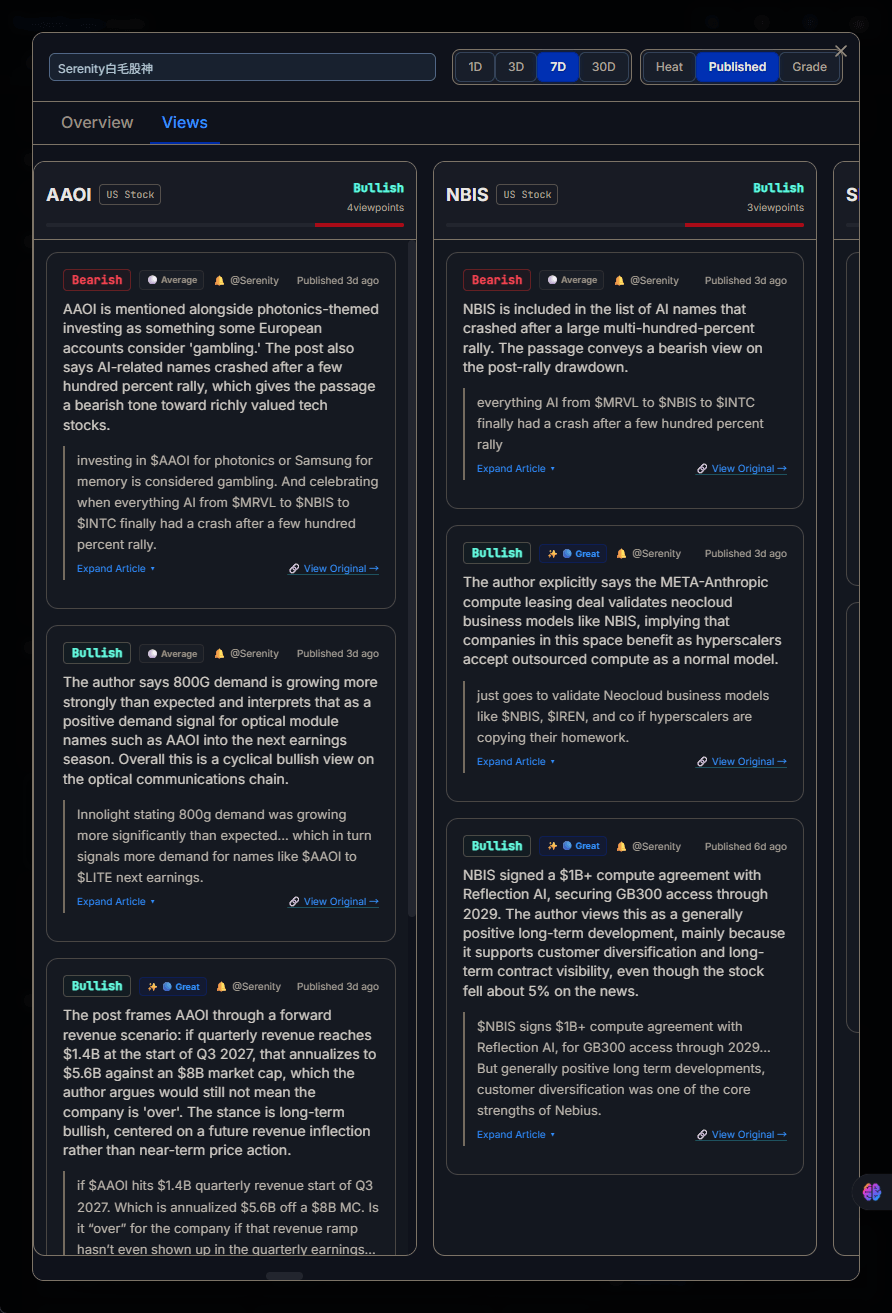
  • Before entering a trade: Open the asset. See all trader views about this specific asset in one place. Bull/bear ratio, recent sentiment shifts, which traders changed their stance.
  • While in a trade: Monitor sentiment changes on this asset specifically. Has the bull/bear ratio shifted? Which traders flipped? Don't scan feeds β€” check the asset.
  • After exiting: Review how trader sentiment evolved during your trade. Was the sentiment signal early, accurate, or misleading? This calibration makes you better at reading sentiment next time.
Try this today: Pick one asset you're watching. Instead of scrolling your feed, search specifically for what the traders you follow have said about this asset in the last week. Write down the bull/bear ratio. You'll instantly have a clearer picture than 30 minutes of feed scrolling.

Building Your Trader Filter List

The quality of your trader sentiment signal depends entirely on who you filter. Here's a framework for building a useful watchlist:

Tier 1: Core Signal (3-5 traders)

Traders whose views on specific assets you trust implicitly. You know their style, their risk tolerance, and their track record. When they post about an asset you watch, you pay attention. These are your high-conviction filters.

Tier 2: Context (5-10 traders)

Traders who are knowledgeable but not always right on the assets you care about. Their views add texture β€” especially when they disagree with Tier 1. Sentiment divergence between tiers is often the most interesting signal.

Tier 3: Scan (10-20 traders)

Broad market participants whose posts help you spot new assets and trends. You don't trade based on their calls, but they help you know what's moving and why. This group generates ideas that you validate through Tier 1 and 2.

In each tier, the key is to tag traders by the assets they actually cover. A trader who nails crypto might be noise on equities. Filtering by asset-tagged trader lists transforms noise into signal.

Sentiment Drift: When to Pay Attention

Not all trader opinions are equally important. The signal value spikes when:

  • Multiple independent traders flip simultaneously. Three Tier 1 traders going bearish on the same asset is a signal. One trader flipping is noise.
  • Tier 1 and Tier 2 diverge. When your highest-conviction traders disagree with the broader group, something interesting is happening β€” either a contrarian opportunity or a hidden risk.
  • Sentiment changes before price moves. This is the holy grail. If you catch trader sentiment shifting before the chart confirms, you have a timing edge.
Rule of thumb: Individual trader posts = data. Aggregated sentiment by asset = signal. Don't confuse the two.

Closing the Loop: From Trader Views to Your Trade

Following traders is valuable only when it changes what you do. Here's the feedback loop that turns other people's opinions into your edge:

  1. Capture: Trader posts about an asset β†’ tagged and stored, not lost in feed.
  2. Aggregate: All views on that asset β†’ bull/bear ratio, sentiment trend, who said what.
  3. Plan: Before entering, check the aggregated sentiment for the asset. Is it aligned with your thesis? If not, why are you trading against the crowd?
  4. Execute: Enter with a plan that accounts for the sentiment context.
  5. Review: After exit, look back at what sentiment was at entry vs. exit. Did the traders front-run or lag the move?

This cycle turns following traders from passive consumption into an active edge. And it only works when step 1-5 happens on the same asset page β€” not across five different apps.

Why TradeScope Flips the Model

TradeScope was built on a simple premise: trader sentiment belongs on the asset, not in a feed. Instead of going to 15 sources to find what people are saying about BTC, you go to BTC and see what the traders you follow are saying β€” aggregated, tagged, and time-stamped.

This reverses the information flow:

  • Old model: Follow sources β†’ stumble on trades β†’ context is scattered
  • TradeScope model: Pick an asset β†’ see all trader context β†’ decide with clarity

The difference isn't subtle. It's the difference between navigating with a map on your phone and navigating with 20 maps spread across 5 tables in a dark room.

Next step: Stop scrolling feeds for trade ideas. TradeScope aggregates trader sentiment by asset so you have context where it matters most. Try it free β†’

Stop Scrolling. Start Trading with Context.

Trader sentiment aggregated by asset β€” no more feed noise.

Get Started Free β†’