How to Read Market Sentiment Like a Professional Trader
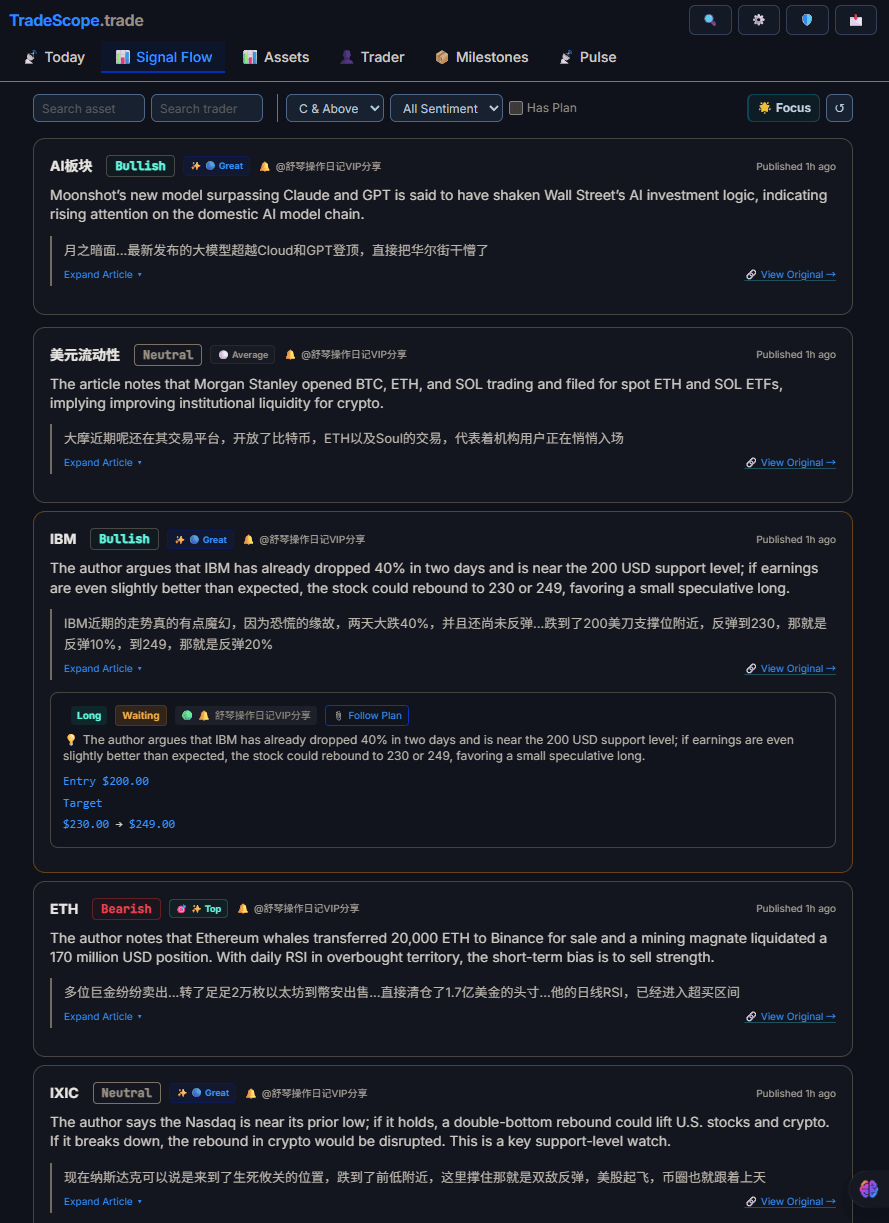
Market sentiment feeds consolidate noise into actionable signals.
Every trader has been there: you open a chart, spot what looks like a clean setup, and pull the trigger. Then the market moves against you — hard. You check Twitter, Reddit, the news, and suddenly everyone seems to have seen it coming. They didn't, of course. But the crowd was telling a story you weren't reading.
Market sentiment is that story. It's the collective emotional state of everyone trading, investing, and commenting on the market right now. And professional traders don't just glance at it — they build it into every decision they make. Here's how you can do the same.
What Market Sentiment Actually Measures
Market sentiment is the aggregate emotional state of market participants — how people feel about the market, not what the technical indicators or balance sheets say. It's a gauge of crowd psychology, and it's one of the oldest concepts in trading. Jesse Livermore was reading the crowd in the early 1900s; today we just have better data to do it.
Here's the critical distinction most beginners miss: sentiment is not a predictor. It doesn't tell you where price is going. It tells you where the crowd thinks price is going. Those are very different things. The crowd can be right for a while and catastrophically wrong at turning points — which is exactly when the information becomes most valuable.
So why use it at all? Because markets are driven by human decisions. Algorithms execute trades, sure, but humans set the parameters, write the code, and — most importantly — panic and get greedy. Understanding the emotional backdrop helps you position yourself on the right side of those decisions.
Sentiment data comes from several sources:
- Social media analysis — scraping Twitter, Reddit, Telegram, and Discord for mentions, tone, and volume of discussion around specific assets.
- Survey data — classic polls like the AAII Investor Sentiment Survey (stocks) or the crypto Fear & Greed Index.
- Derivatives positioning — funding rates on perpetual futures, put/call ratios in options markets, and options open interest distribution.
- Fund flows — money entering or leaving ETFs, exchanges, and DeFi protocols.
Professional traders use sentiment as one input among many. It's a filter, not a trigger. You wouldn't build a house with only a level — you need a tape measure, a square, and a plan too. Sentiment is one of those tools.
The Bull/Bear Ratio: Your Starting Point
The bull/bear ratio is the most straightforward sentiment metric you'll encounter. It's simply the percentage of traders who are bullish divided by the percentage who are bearish. Some platforms calculate it from survey data; others derive it from positioning. Either way, the interpretation is the same.
In a normal, trending market, the ratio sits somewhere between 1.0 and 2.0. That's healthy — slightly bullish is the default state of markets that spend more time going up than down over the long run.
But extremes are where the signal lives:
| Bull/Bear Ratio | Interpretation | Action |
|---|---|---|
| 2.5 – 3.0+ | Extreme bullishness | Potential contrarian short signal — be cautious with longs |
| 1.0 – 2.0 | Normal range | No strong signal — rely on other analysis |
| 0.5 and below | Extreme bearishness | Potential contrarian long signal — look for entries |
Two real-world examples make this concrete:
When Bitcoin hit its all-time high of $69,000 in November 2021, bull/bear ratios across major platforms were sitting at 4.2. Nearly every retail trader was bullish. Institutional funding was pouring in. Social media was euphoric. That was the signal — not to short (timing that is nearly impossible), but to start tightening stops and taking profits on existing longs. A month later, BTC was below $50,000.
Conversely, during the bear market low in June 2022, when Bitcoin bottomed around $18,000, the ratio hit 0.3. That's not just bearish — that's capitulation. Traders were exiting positions en masse, social media had gone silent, and surveys showed record pessimism. Within six months, BTC had recovered above $25,000. Those who were paying attention to the ratio had a data-driven reason to start accumulating.
The important nuance: don't trade on the ratio alone. A ratio of 3.5 doesn't mean "short Bitcoin tomorrow." It means "the crowd is extremely one-sided, so the probability of a reversal has increased." Use it as a filter for setups you've already identified through technical or fundamental analysis.
Social Volume vs Price: Finding Divergences
Social volume is the total amount of mentions, discussions, and commentary about a specific asset across social platforms — Twitter, Reddit, Telegram, Discord, and forums. Under normal conditions, social volume and price move together. More attention leads to more buying or selling, which moves the price.
The interesting signal appears when they diverge.
Divergence #1 — Price rises, social volume drops: Price is climbing, but fewer people are talking about it. This signals weak conviction. The rally is being driven by a shrinking group, not a growing one. When that group stops buying, the rally runs out of fuel. This is one of the most reliable early warnings of a pullback.
Divergence #2 — Price drops, social volume spikes: Price is falling and everyone is panicking in the comments. This is harder to read — it could be genuine capitulation (a bottom signal) or it could be the beginning of a larger panic (a continuation signal). The key is to look for volume to spike and then fade. When the screaming stops and silence follows, the bottom is often forming.
A real example: In early 2026, ETH's price was rising steadily from around $2,800 toward $3,400, but social mentions were declining week over week. The rally wasn't generating excitement — it was being driven by a small cohort of large holders, not broad retail participation. Within three weeks, ETH pulled back 18% to around $2,800 again. Traders who were monitoring the social volume divergence saw the warning signs early.
How do you spot these divergences without manually scrolling through Twitter? Tools like TradeScope's Pulse panel surface social volume anomalies automatically. They compare current volume to historical baselines and flag when the relationship between price and attention breaks down.
One important caveat: social volume divergences work best on daily and weekly timeframes. Intraday social volume is too noisy and reactive to single tweets or news events to provide reliable signals.
Reading Extreme Readings (Fear & Greed)
The Crypto Fear & Greed Index from alternative.me is the most popular single-sentiment metric in crypto. It aggregates volatility, market momentum, social media activity, dominance, and trends into a single number from 0 (Extreme Fear) to 100 (Extreme Greed).
The basic framework is intuitive:
- Extreme Fear (0–25): Historically, these zones have preceded some of the best buying opportunities. Markets are oversold, pessimism is maxed out, and sellers are exhausted.
- Neutral (25–75): The middle ground. Not much signal here — this is where the market spends most of its time.
- Extreme Greed (75–100): Historically, these zones have preceded corrections. Everyone is bullish, leverage is high, and the market is overheated.
But here's where most traders get it wrong: extreme readings can persist for weeks or even months. In late 2021, the Fear & Greed Index stayed above 75 for almost two months while Bitcoin climbed from $50K to $69K. If you had shorted the moment it hit "Extreme Greed," you would have been liquidated before the eventual crash.
The professional approach is to use extreme readings as confirmation, not initiation. You don't open a trade because the index says "Fear." You identify a setup through your normal analysis — support level, trend, volume pattern — and then check sentiment to see if it confirms or contradicts your thesis.
Beyond the Fear & Greed Index, other extreme indicators worth watching include:
- Funding rates going heavily positive (typically above 0.05% per 8 hours) — this means perpetual futures are overleveraged to the long side. When the correction comes, the cascade of liquidations amplifies it.
- Put/call ratio hitting extremes below 0.5 (too many calls relative to puts, everyone betting on upside) or above 1.5 (too many puts, everyone hedging or betting on downside).
- Social media hype cycles — when your non-crypto friends start asking you about a specific token, that's often a late-stage greed signal. When nobody wants to talk about crypto at all, that's often a fear extreme.
Warren Buffett's famous advice applies directly to sentiment trading: "Be fearful when others are greedy, and greedy when others are fearful." But add this qualifier: only with proper risk management. Contrarian signals can be early, and being early looks a lot like being wrong — until it doesn't.
Incorporating Sentiment Into Your Workflow
Knowing about sentiment is one thing. Actually building it into your trading process is another. Here's a practical workflow that works whether you trade crypto, stocks, or forex:
Step 1: Check sentiment at the START of your session, not after you've already decided. This is the most common mistake. Traders form a thesis, enter a trade, and then go looking for sentiment data that confirms what they've already done. That's confirmation bias, not analysis. Check the numbers before you even open a chart.
Step 2: Note the overall market mood. Is the broad market in fear, neutral, or greed? This sets the backdrop. In a fear-dominated market, pullbacks tend to overshoot to the downside. In a greed-dominated market, rallies tend to overshoot to the upside. Knowing this helps you set realistic targets and stops.
Step 3: Check sentiment for the specific asset you're considering. The overall market might be fearful while a specific altcoin has its own bullish sentiment cycle. Drill down to the asset level.
Step 4: Look for divergences between sentiment and price action. If price is grinding higher but sentiment is weakening, that's a warning. If price is falling but social engagement is spiking, that could be capitulation. Divergences are where the edge is.
Step 5: Use extreme readings as position sizing guidance. When sentiment is at an extreme, reduce your position size. You might still take the trade, but you should be doing it with less capital and tighter stops. When sentiment is neutral and your setup is clean, that's when you can trade with more conviction.
Step 6: Record your sentiment observation in your trade journal. Write down the overall mood, the asset-specific ratio, and any divergences you noticed. Over time, this builds a library of how sentiment behaved before your winning and losing trades. Patterns will emerge that are specific to your trading style.
Two common mistakes to avoid:
- Checking sentiment after entry. You've already committed capital. Now you're just looking for reasons to feel good (or panic). Sentiment analysis works backwards — it informs the decision, it doesn't justify it after the fact.
- Using sentiment as the primary entry signal. "The Fear Index is at 12, so I'm buying" is not a strategy. Sentiment is a filter, not a trigger. Your entry should come from a technical setup, a fundamental catalyst, or a combination. Sentiment adds context and confidence.
Sentiment Checklist: Before Every Trade
Theory is great, but execution requires a process. Here's a sentiment checklist to run before every trade. Print it out, save it on your phone, or keep it on your desk — whatever works. The goal is to make sentiment analysis automatic, not optional.
If you run this checklist before every single trade for 30 days, you'll start to see patterns. You'll notice that your win rate improves when sentiment confirms your setup. You'll notice that you lose more when you ignore divergences. That data becomes part of your edge.
Don't overcomplicate it. The checklist exists to force a 60-second pause between "I think I should trade this" and "I'm clicking buy." That pause is where money is saved.
How TradeScope's Sentiment Dashboard Helps
All of the metrics and processes described above are exactly what TradeScope's Sentiment Dashboard was built to deliver — in one unified view, updated in real time.
Instead of hopping between the Fear & Greed Index site, Twitter analytics, a futures dashboard, and a survey page, TradeScope puts it all together:
- Real-time bull/bear ratios across crypto, stock, and forex markets — not just one survey, but aggregated positioning data from multiple sources.
- Social volume tracking with automatic divergence detection. TradeScope compares current social volume against its 30-day baseline and flags divergences from price action. You don't have to eyeball it — the system surfaces anomalies for you.
- Extreme reading alerts. When sentiment metrics hit extreme levels — whether it's a funding rate spike, a Fear & Greed Index extreme, or an unusual social volume surge — you get notified. You don't have to watch screens all day.
- Linked to your Trade Plan. This is the key differentiator. Sentiment data isn't in a separate tab you forget to check — it's right next to your trade plan, your strategy notes, and your position tracker. You see sentiment alongside your own analysis, in context, every time you plan a trade.
The goal isn't to hand you trading signals. It's to give you the same information that professional traders spend hours assembling each morning — in a single dashboard that takes seconds to review.
Market sentiment won't make you a profitable trader on its own. But ignoring it is like trading with one eye closed. The crowd is talking. You just need to know how to listen.
Try TradeScope's Sentiment Dashboard free at tradescope.trade/app — and start making sentiment part of your edge.