Market Sentiment Indicators Every Trader Should Understand
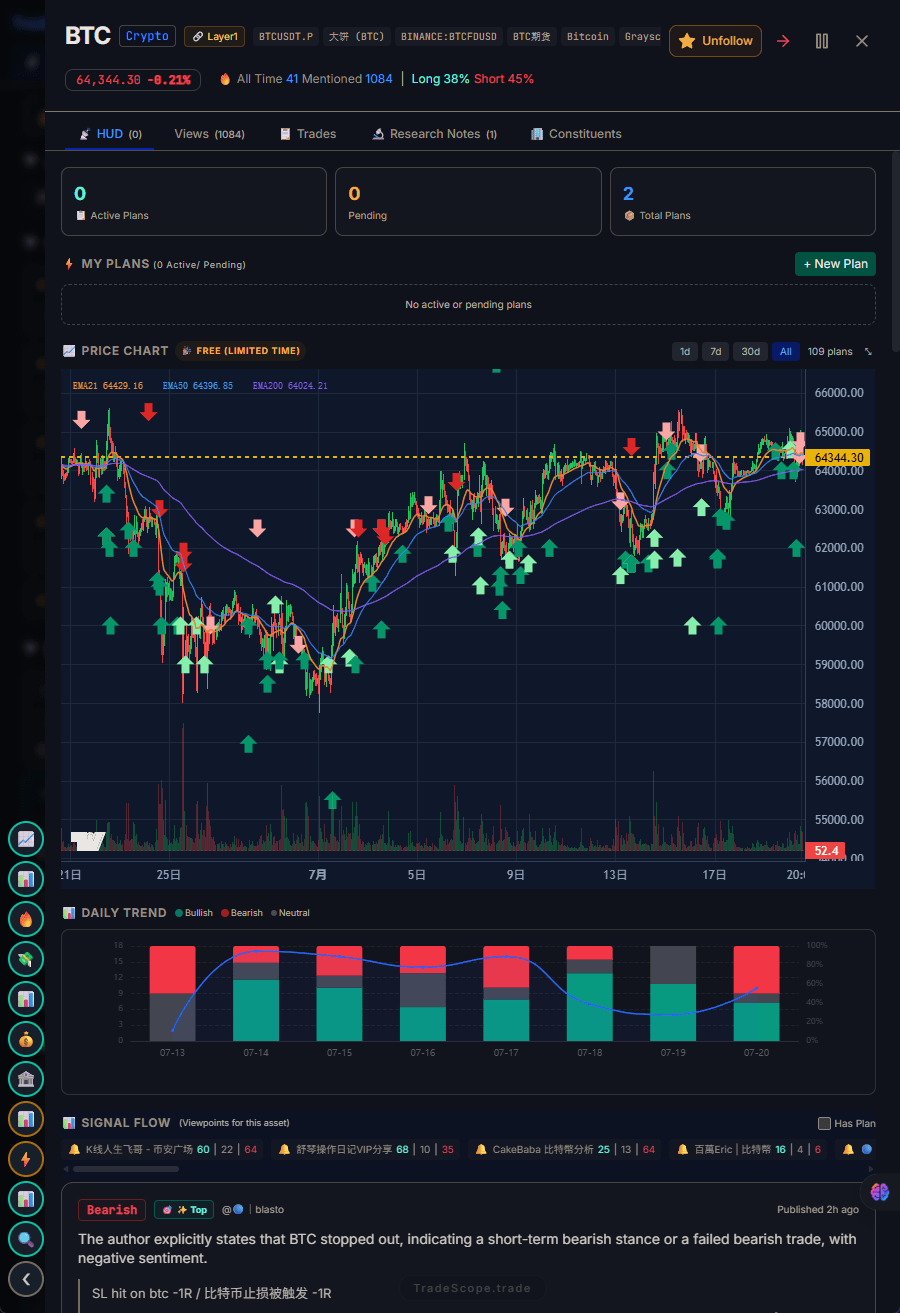
Sentiment indicators are anchored to each asset, so you always have context.
Sentiment indicators are the vital signs of market psychology. While price tells you what the market is doing, sentiment indicators tell you how the market is feeling — and that's often where the real edge lies. Price action reflects the outcome of decisions already made. Sentiment reveals the pressure building beneath the surface, the positioning that precedes the next big move.
In this guide, we'll break down the 7 most important sentiment indicators every trader should have in their toolkit — what each one measures, how to interpret extreme readings, and most importantly, how to combine them into a coherent framework for decision-making.
📑 Table of Contents
What Are Sentiment Indicators?
Sentiment indicators are metrics that measure the collective mood, positioning, or behavior of market participants. Unlike price or volume — which are objective records of what happened — sentiment indicators attempt to quantify the psychological state of the market. They can be derived from options markets, funding rates, social media activity, trader surveys, or behavioral patterns in trading volume.
The foundation of sentiment analysis rests on a powerful behavioral insight: when sentiment reaches extremes, the market often does the opposite of what the majority expects. This is the core principle of contrarian investing. Crowds are usually right in the middle of a trend, but dangerously wrong at inflection points. Sentiment indicators help you identify those inflection points.
Think of it this way — if everyone who wanted to buy has already bought, there's nobody left to push the price higher. If everyone who wanted to sell has already sold, the path of least resistance becomes upward. Sentiment indicators help you detect these moments when the crowd is most one-sided.
It's worth noting that no single sentiment indicator is a crystal ball. Each one captures a different facet of market psychology, and each has blind spots. The real power comes from reading them in context — which we'll cover in the final section.
Fear & Greed Index
The Crypto Fear & Greed Index is the most widely recognized sentiment indicator in the cryptocurrency market. Originally popularized by Alternative.me, it provides a single number that attempts to capture the overall emotional state of crypto investors.
How It Works
The index combines 7 distinct metrics into a composite score:
- Volatility — Current volatility relative to 30/90-day averages. Extreme volatility suggests fear.
- Market Momentum — Current price relative to moving averages. Strong upward momentum suggests greed.
- Volume — Trading volume compared to recent averages. Surging volume can indicate either fear selling or greed buying.
- Social Media Activity — Volume and sentiment of crypto-related social posts. Spikes often correlate with emotional extremes.
- Bitcoin Dominance — Bitcoin's share of total crypto market cap. Rising dominance often signals a flight to safety (fear).
- Trends — Google Trends data for crypto-related search terms. High search volume often coincides with retail FOMO.
- Google Trends — Specific search queries that correlate with market tops and bottoms.
Reading the Scale
The index runs from 0 (Extreme Fear) to 100 (Extreme Greed), divided into five zones:
| Range | Zone | What It Suggests |
|---|---|---|
| 0 – 25 | 🔴 Extreme Fear | Potential buying opportunity, especially for fundamentally strong assets |
| 26 – 49 | 🟠 Fear | Caution warranted; market is nervous but not panicked |
| 50 | ⚪ Neutral | Balanced sentiment; no clear emotional bias |
| 51 – 74 | 🟢 Greed | Market is optimistic; start monitoring for overextension |
| 75 – 100 | 🟢 Extreme Greed | Potential distribution phase; consider taking profits |
💡 Key Insight: The Fear & Greed Index is most useful as a contrarian indicator — when others are fearful, there may be opportunity. Bitcoin historically bottomed in 2018 and 2022 when the index was in Extreme Fear for extended periods. But remember: markets can stay irrational longer than you can stay solvent. Extreme fear can persist for weeks.
Put/Call Ratio
The Put/Call Ratio (PCR) is derived from options markets and measures the balance between bearish bets (put options) and bullish bets (call options). It's one of the most direct reads on how traders are positioning through derivatives.
The Formula
PCR = Put Volume / Call Volume
A PCR of exactly 1.0 means equal volumes of puts and calls are being traded. Deviations from this baseline reveal directional bias in the options market.
How to Interpret Readings
| PCR Range | Interpretation | Implication |
|---|---|---|
| > 1.0 | More puts than calls | Bearish positioning — often signals a market bottom |
| 0.7 – 1.0 | Balanced to slightly bearish | Normal range; no extreme signal |
| < 0.5 | Heavy call buying | Bullish euphoria — often signals a market top |
The contrarian logic is straightforward: when everyone is buying puts, they've already expressed their fear. There's less selling pressure remaining. When everyone is buying calls, the market is leveraged long and vulnerable to a correction.
💡 Note: The Put/Call Ratio is more relevant for crypto on platforms like Deribit and OKX that offer robust options markets. For assets without deep options liquidity, this metric is less reliable. Always check the volume underlying the ratio — a PCR of 1.3 on 100 contracts means far less than a PCR of 1.3 on 50,000 contracts.
Funding Rates
Funding rates are unique to perpetual futures contracts — a product that dominates crypto derivatives trading. Unlike traditional futures that have an expiration date, perpetuals never expire. To keep the perpetual price tethered to the spot price, the exchange collects or pays a periodic "funding" fee between long and short traders.
How Funding Works
- Positive funding rate → Longs pay shorts. This means bullish positioning is dominant. The market is willing to pay a premium to stay long.
- Negative funding rate → Shorts pay longs. This means bearish positioning is dominant. The market is paying a premium to stay short.
Extreme Readings to Watch
Funding rates become most informative when they reach extremes:
- Funding above +0.1% per 8 hours — The market is extremely leveraged long. This often precedes sharp corrections, as a cascade of liquidations can unwind positions violently. This is the zone where "long squeeze" events originate.
- Funding below -0.05% per 8 hours — Heavy short positioning. This often precedes relief rallies or short squeezes. When shorts are paying this much to hold their positions, a price bounce can trigger a cascade of short liquidations.
💡 Pro Tip: High funding + rising price = watch for a squeeze in either direction. The funding tells you who's leaning and how far. The bigger the lean, the more violent the correction when it comes. Funding rates are one of the best real-time gauges of leveraged positioning — something no other indicator captures as directly.
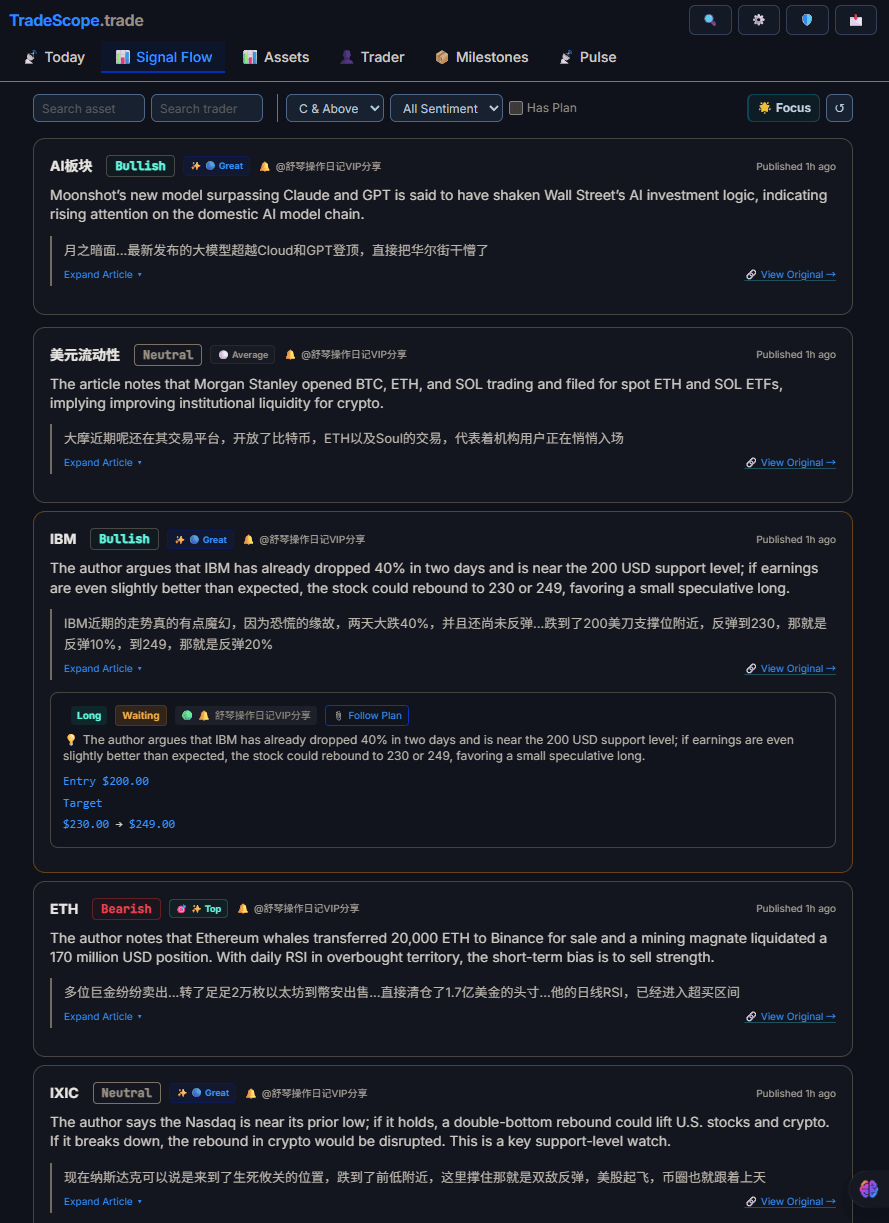
Real-time sentiment signals help you read the market's emotional state.
Social Volume
Social volume measures the number of mentions, discussions, and posts about a crypto asset across social media platforms — including Twitter/X, Reddit, Telegram, Discord, and other crypto communities. It's a direct proxy for public attention and retail interest.
What Social Volume Reveals
- Spikes in social volume often precede significant price moves. When a coin starts trending on social media, it's usually because something is happening — or about to happen. Attention precedes action.
- Low social volume during an accumulation phase can be the quiet before the storm. Smart money often buys when nobody is paying attention. When social volume is low but on-chain accumulation is rising, it's a classic setup.
- High social volume during a rally often signals retail FOMO is active. This is when latecomers pile in — and when early positions start distributing.
The nuance matters here. Social volume alone doesn't tell you whether the conversation is positive or negative. A spike in social volume driven by panic selling is very different from a spike driven by excitement about a new product launch. That's why social volume works best when paired with sentiment analysis of the content itself.
Tools to Track Social Volume
Several platforms provide social volume data: LunarCrush aggregates social media metrics across multiple platforms; Santiment provides detailed social analytics on crypto assets; and TradeScope integrates social volume directly into its Trading HUD alongside other sentiment layers — so you don't need to check three separate dashboards.
Bull/Bear Ratio
The Bull/Bear Ratio measures the proportion of bullish vs. bearish positions or opinions across a trading platform, survey, or market. It's one of the most intuitive sentiment indicators because it directly answers the question: Which side is the crowd on?
Reading the Ratio
The ratio scales from 0% (all bearish) to 100% (all bullish), with 50/50 representing a perfectly divided market.
- 80%+ Bullish: Markets often correct within 2–4 weeks. When the overwhelming majority is positioned long, there's limited buying power left to push prices higher.
- Below 20% Bullish: Recovery tends to follow. When almost everyone has capitulated and gone bearish, the market often reverses.
The Bull/Bear Ratio is particularly powerful because it captures actual positioning rather than just opinions. When you look at what traders are doing with their money — not just what they're saying on social media — you get a much more reliable signal.
TradeScope tracks bull/bear ratio per asset based on actual trader positions, giving you a real-time view of how traders are positioned across your watchlist. This makes it easy to spot divergences — when price is rising but the Bull/Bear Ratio is falling, it's a warning sign that the rally may not have broad support.
VIX — Volatility Index
The CBOE Volatility Index (VIX), often called the "fear gauge," measures the market's expectation of 30-day volatility in the S&P 500. While it originates in traditional equity markets, its implications extend to every risk asset class — including crypto.
How VIX Works
The VIX is derived from the prices of S&P 500 index options. When option buyers are paying higher premiums for protection (puts), the VIX rises. When complacency reigns and options are cheap, the VIX falls.
| VIX Level | Interpretation | Crypto Implication |
|---|---|---|
| < 15 | Low volatility / complacency | Risk-on environment; crypto tends to benefit |
| 15 – 25 | Normal range | Moderate uncertainty; crypto may be range-bound |
| 25 – 35 | Elevated fear | Risk-off moves; expect crypto selling pressure |
| > 35 | Extreme fear / crisis | Broad liquidation across all risk assets including crypto |
Why crypto traders should care: While the VIX doesn't directly measure crypto volatility, it reflects overall risk appetite across global markets. When institutional investors are de-risking (selling equities, buying protection), they're also reducing crypto exposure. This correlation has become especially pronounced during macro-driven events — rate decisions, banking crises, geopolitical shocks.
During periods of high VIX, even fundamentally strong crypto assets tend to sell off simply because the "risk-on" trade is unwinding globally. Monitoring the VIX gives you an early warning of macro headwinds that no on-chain metric can capture.
How to Combine Multiple Indicators
No single sentiment indicator gives the full picture. Each one captures a different slice of market psychology, and each has its own biases and blind spots. The real power — and the real edge — comes from combining multiple indicators into a layered framework.
The Three-Layer Framework
Layer 1 — Macro Environment
VIX + Fear & Greed Index = Overall risk appetite across global markets. This tells you whether the wind is at your back or in your face.
Layer 2 — Positioning
Funding Rates + Put/Call Ratio = How traders are positioned through derivatives. This tells you where the leverage is and which direction is overcrowded.
Layer 3 — Social & Sentiment
Social Volume + Bull/Bear Ratio = What the crowd is saying and doing. This tells you whether retail is participating, and which side they're on.
When All Layers Align
The strongest signals occur when all three layers point in the same direction. Consider this scenario:
- VIX spiking above 30 → Macro is in risk-off mode
- Fear & Greed Index at 12 (Extreme Fear) → Crypto market is terrified
- Funding rates deeply negative (-0.08%) → Shorts are dominant and paying to hold
- Put/Call Ratio at 1.4 → Options traders are heavily positioned for downside
- Social volume collapsing → Retail has left the building
- Bull/Bear Ratio at 15% → Almost nobody is bullish
When you see all six indicators flashing the same signal — in this case, extreme fear across every dimension — that's often the highest-conviction contrarian buy signal in the market. Not because "buy when others are fearful" is a magic formula, but because you've verified the fear is real, broad, and deeply positioned. The crowd has fully expressed its bearishness, which means the selling pressure is likely exhausted.
The reverse is equally powerful. When funding rates are screaming positive, the Fear & Greed Index is at 90, social volume is at all-time highs, and the Bull/Bear Ratio is at 85% — the market is one-sided in a dangerous way.
Why This Matters
The challenge for most traders isn't knowing that sentiment matters — it's that checking all these indicators across different platforms takes time and creates cognitive load. You end up checking the Fear & Greed Index on one site, funding rates on another, social metrics on a third, and by the time you've synthesized everything, the market has already moved.
This is exactly the problem a Trading HUD solves. A Trading HUD — like the one TradeScope provides — aggregates all these sentiment layers into a single, real-time dashboard. You see your trading plan, opinion radar, sentiment gauges, and pulse signals all in one view. No tab switching. No information lag. Just a complete read on the market in seconds.
📊 Ready to see all sentiment indicators in one place?
TradeScope's Trading HUD combines Fear & Greed, funding rates, social volume, bull/bear ratio, and more — all in a single dashboard built for active traders.