How to Build Your Own Trader Watchlist (Step-by-Step)
Every successful trader I know has one thing in common: they don't try to follow everyone. They have a curated watchlist — a small, carefully selected group of traders whose insights actually matter to their strategy. Meanwhile, struggling traders follow hundreds of accounts, drown in conflicting signals, and can't figure out why they keep getting whipsawed.
The difference isn't talent. It's information architecture. And building a proper trader watchlist is one of the highest-leverage things you can do for your trading — in about two hours of work.
Why a Watchlist Beats Following Everyone
Most traders follow way too many people. Fifty accounts. A hundred. Some follow over five hundred Twitter accounts, multiple Discord servers, and a dozen Telegram channels. The result? Information overload. Conflicting signals. Decision paralysis.
Here's the problem: when you follow 300 traders, you'll hear 300 different opinions on the same asset. Bullish. Bearish. Neutral. "Wait for the breakout." "Short the dump." "Stay cash." You end up doing nothing because every possible perspective cancels out every other perspective. You're not informed — you're paralyzed.
A watchlist flips this dynamic. Instead of 300 noisy sources, you follow 15 to 20 high-signal traders whose styles, strategies, and asset focuses align with yours. Quality over quantity — always. One great trader's insight is worth more than a hundred mediocre takes.
With a curated watchlist, you can:
- Spot consensus — When multiple high-quality traders agree on a setup, that signal is meaningful
- Detect divergence — When your best traders disagree, it means you need to be careful
- Track consistency — You can evaluate performance over weeks and months, not just lucky calls
- Reduce noise — Less information doesn't mean less insight; it means less FOMO and fewer impulsive trades
Think of it like building a stock portfolio. You don't buy every stock in the S&P 500 — you pick carefully based on your thesis. Your watchlist works the same way. It's a portfolio of information sources, and like any portfolio, diversification has diminishing returns. Past a certain point, more inputs just create more noise.
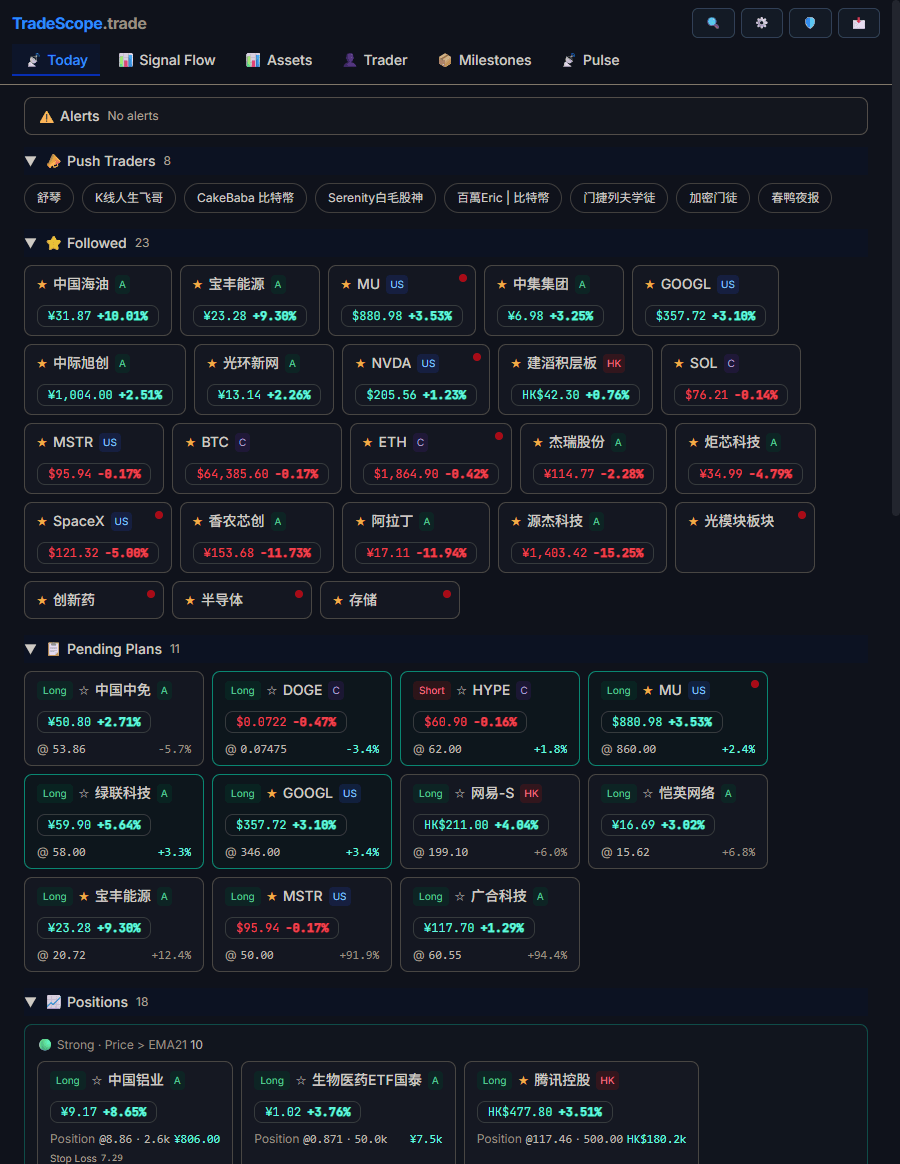
Build and manage your trader watchlist to track the best signal sources.
Step 1: Define Your Selection Criteria
Before you add a single trader to your list, you need clear criteria. Without them, you'll add whoever's trending or whoever just posted a sexy PnL screenshot. That's not a watchlist — that's a popularity contest.
Must-Have Criteria
| Criteria | What to Look For | Why It Matters |
|---|---|---|
| Verifiable Track Record | Actual performance data, not just claims | Screenshots can be faked. Third-party verified data cannot. |
| Consistency | Clean, repeatable strategy over time | A random approach produces random results. You need someone who does the same thing well, repeatedly. |
| Transparency | They show losses, not just wins | Every trader loses. The ones who hide losses are either dishonest or delusional — neither helps you. |
| Time in Market | At least 6 months, ideally 12+ | Anyone can look good for a month. You need to see how they perform across different market conditions. |
| Style Match | Scalper, swing, or position trader — whatever matches your plan | Following a scalper when you're a swing trader creates confusion, not insight. |
| Communication Quality | They explain the WHY behind trades | Blind signals don't teach you anything. You want traders who help you think, not just tell you what to do. |
Nice-to-Have Criteria
- Similar asset focus — crypto, stocks, forex, or a specific niche within them
- Similar risk tolerance — a degen on 50x leverage won't help your conservative approach
- Educational content — they help you learn, not just copy
- Active but not spammy — posts regularly enough to be useful, but not 50 times a day flooding your feed
Write these criteria down. Seriously. Put them in a note, a spreadsheet, or a text file. When you're evaluating a potential addition, reference your criteria list. It keeps you honest and prevents "recency bias" — adding someone just because they nailed one big call last week.
Step 2: Find Potential Traders to Add
Now that you know what you're looking for, here's where to look:
- TradeScope ViewPoint Radar: Browse verified traders filtered by performance metrics, trading style, and asset focus. This is the fastest way to find high-signal traders because the data is already aggregated and verified.
- Twitter/X: Search for traders who regularly share PnL screenshots and detailed analysis — not just memes and hot takes. Look for threads that explain trade rationale, not just "BTC to $100K" predictions.
- Discord / Telegram groups: Many quality trading communities have verified trader channels. The key word is "verified" — if a group lets anyone post signals, run.
- Leaderboard platforms: eToro Popular Investors, Zignaly signal providers, and similar platforms expose performance data publicly. Use it.
- Referrals: Ask other traders in your network who they follow and why. Personal recommendations carry weight, especially when the recommender has a track record you trust.
Step 3: Verify Before You Follow
This step is where most people skip ahead and regret it later. Trust, but verify.
Here's your verification checklist:
- Check claims against actual data. Don't trust screenshots alone — anyone can Photoshop a PnL. Look for third-party verified performance or on-chain evidence of their positions.
- Look for consistent performance, not just one big win. A trader who made 500% on one lucky trade but lost money every other month is not consistent. You want steady, repeatable edge.
- Review their losing trades. How do they handle losses? Do they cut losers quickly? Or do they hold losers hoping they come back, then quietly delete the losing calls? This tells you everything.
- Check if they've been through both bull and bear markets. Anyone can look like a genius in a bull run. The real test is how they navigate a sustained downtrend. Traders who only started in 2024 haven't been tested yet.
- Evaluate their risk management. Do they use stop losses? How do they size positions? A trader making 30% per month but risking their entire portfolio to do it is not someone to emulate.
- Run a 2-4 week paper test. Before adding anyone to your core watchlist, follow them on a "paper watchlist" — just observe. After a few weeks, ask yourself: did their insights actually help me make better decisions?
This verification step is the difference between building a watchlist that makes you money and building one that just makes you feel like you're doing something. Data beats vibes.
Step 4: Organize by Category
Not all traders serve the same purpose. Organizing your watchlist into categories helps you understand why you're following each person and how their insights should weight into your decisions.
| Category | Size | Purpose |
|---|---|---|
| Core | 5-7 traders | Your primary sources. High trust, strong track record, align with your strategy. These are the voices you weight most heavily. |
| Watch | 3-5 traders | Promising but unproven. Still in your evaluation period. They might graduate to Core or get removed. |
| Macro | 2-3 traders | Focus on big-picture analysis — market cycles, macro trends, protocol-level changes. Not specific trade signals, but context. |
| Contrarian | 1-2 traders | Traders who often disagree with consensus. Useful for checking your own bias. When everyone's bullish and your contrarian is cautious — pay attention. |
This categorization isn't just organizational — it's strategic. When you're about to take a trade, you can quickly scan each category: Do my Core traders agree? What does my Macro source say about the broader environment? Is my Contrarian signaling a warning?
That's multi-signal analysis. And it's infinitely better than reacting to whatever the last person you followed tweeted.
Step 5: Maintain and Prune Your List
A watchlist is a living document, not a set-and-forget. Markets change, traders evolve, and your needs shift. Monthly maintenance keeps your list sharp.
Your Monthly Review Process
- Evaluate each trader: Is this person still adding value to my decision-making? If you can't remember the last time their insight helped you, that's your answer.
- Remove underperformers: Traders who become inconsistent, start shilling paid services, change their strategy, or go silent should be removed. Your watchlist is not a hall of fame — it's a working tool.
- Add new discoveries: As you browse TradeScope, Twitter, or trading communities, you'll find new traders who meet your criteria. Add them to your Watch category for evaluation.
- Track usage: Ask yourself honestly — how often did I actually act on each trader's insights this month? If you rarely use someone's input, they're taking up space. Remove them.
- Rebalance categories: A Watch trader who's proven themselves for 3+ months might graduate to Core. A Core trader who's been inconsistent might move to Watch. Let the data drive the decision.
The goal is a watchlist that gets better over time — more refined, more aligned with your strategy, and more valuable per trader followed.
Common Mistakes to Avoid
Even with the right process, traders fall into predictable traps. Here are the most common:
- Following too many people. Start with 10-15 and hard-cap at 20. Beyond that, the marginal value of each additional source drops below the noise they add.
- Adding traders based on one big call. Recency bias is real. One correct prediction doesn't make someone worth following. You need a track record, not a highlight reel.
- Not verifying track records. "Trust but verify" isn't a cliché — it's survival. Many popular traders have mediocre or negative actual performance. The loudest voices aren't always the best.
- Following traders with a different style. A high-frequency scalper's signals won't help your weekly swing trading. Style mismatch creates confusion and bad entries.
- Never pruning. Your watchlist should evolve as you evolve. A list that hasn't changed in six months is probably stale.
- Blind copying without understanding. The goal is to learn from other traders' analysis, not to blindly mirror their positions. If you don't understand why a trade makes sense, you won't be able to manage it when it goes against you.
- Adding friends or entertainers. Someone being entertaining or being your friend doesn't make them a good trader. Keep personal relationships and trading information sources separate.
Building Your Watchlist in TradeScope
All of this might sound like a lot of work. And building a watchlist from scratch — manually searching Twitter, evaluating every claim, organizing into categories — genuinely takes time.
That's exactly why we built TradeScope's ViewPoint Radar.
ViewPoint Radar gives you a head start on every step of this process:
- Browse verified traders filtered by performance metrics, win rate, trading style, and asset focus — no more guessing or relying on unverifiable screenshots
- Add traders to your Watchlist with one click — organize them by your categories, track them over time, and manage everything in one dashboard
- View consensus scores — instantly see what your watched traders think about any asset, with individual breakdowns showing who's bullish, who's bearish, and who's staying out
- Multi-signal analysis — see sentiment data alongside trader views, so you're not relying on a single data point to make decisions
- Track consistency over time — the platform helps you evaluate whether a trader's recent calls fit their overall track record, not just their latest tweet
Think of TradeScope as the infrastructure layer for your watchlist. Instead of cobbling together Twitter lists, spreadsheet trackers, and Discord bookmarks, you get a single, purpose-built system designed for exactly this workflow.
Start Building Your Watchlist Today
A well-built watchlist is one of the few edges that compound over time. The longer you run it, the better it gets — and the better your trading decisions become.
You don't need to follow five hundred accounts. You need to follow the right fifteen.
Related Articles
How to Follow Traders
A practical framework for choosing which traders to follow and why.
Best Trader Aggregators for Crypto
Compare the top platforms for tracking crypto traders in one place.
LunarCrush Alternatives
Explore alternatives to LunarCrush for social analytics and trader insights.
What Is a Trading HUD?
Learn why a unified trading dashboard beats scattered tools.